
Frameless vs Framed Shower Cubicles: Which Is Right for Your Bathroom?
5 min read · Published

Husseini Builders
Fabrication and installation specialists
- Homeowner
- Comparison
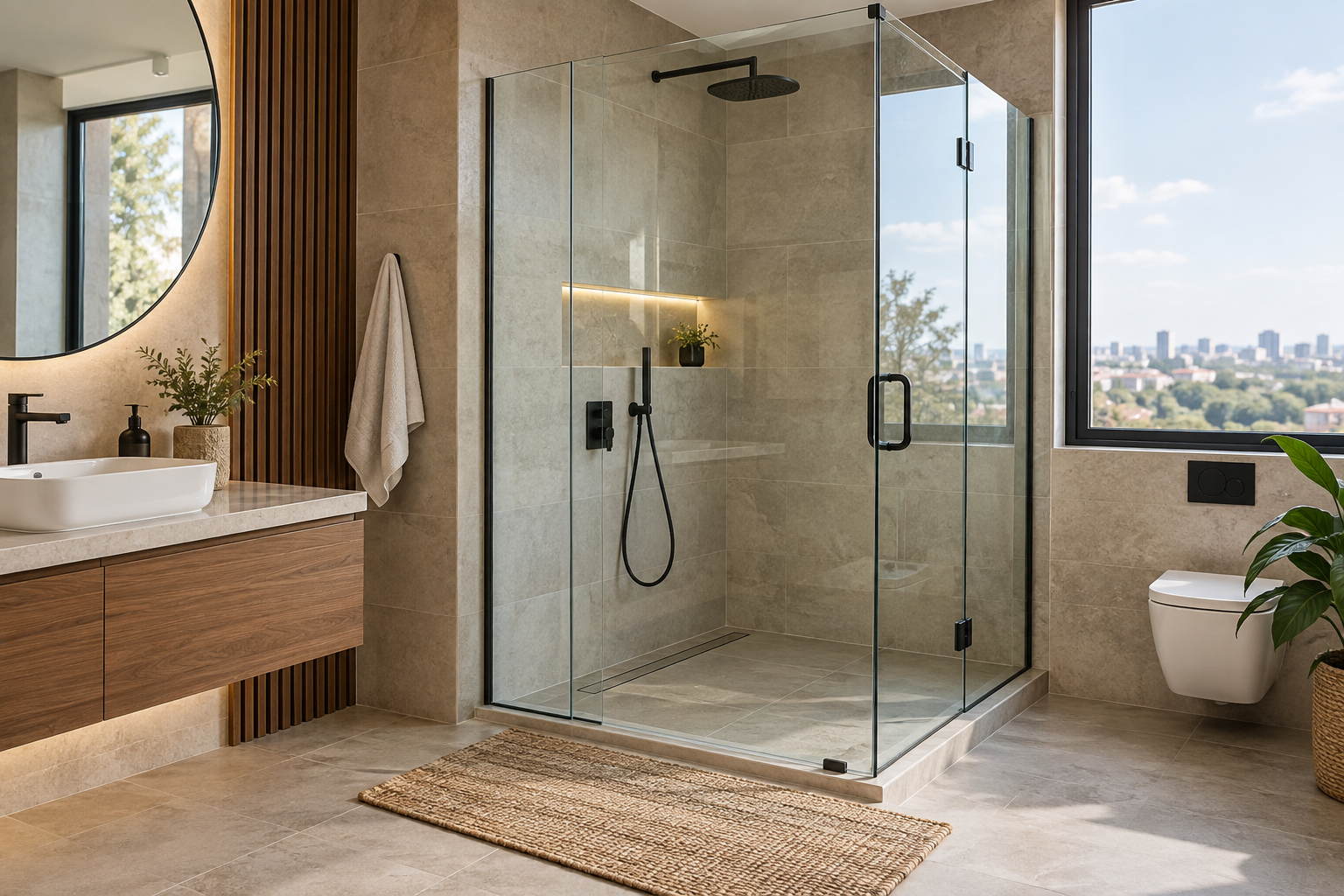
Frameless or framed shower cubicle? Compare looks, cost, glass thickness, waterproofing and maintenance to choose the right glass shower enclosure for your Nairobi home.
A frameless shower cubicle uses thick toughened glass held by minimal hardware, for a clean, open look at a higher price and with stricter installation requirements. A framed shower cubicle uses thinner toughened glass in an aluminium frame, costs less, seals more easily, and is more forgiving of walls that are not perfectly straight. A semi-frameless option sits between the two. The right choice depends on your bathroom, your walls and your budget, not just on which looks better in a photograph.
This guide compares the two honestly, so you can choose before you ask for a quote.
What is the difference between a frameless and a framed shower cubicle?
Frameless. The glass itself does the structural work. Panels are typically 8 to 10 millimetres of toughened glass, fixed with hinges, clamps and a minimal channel or U-profile. There is no visible frame around the edges. The result is a cubicle that almost disappears, which is why it dominates modern bathroom design.
Framed. An aluminium frame runs around the glass panels and doors, and the glass is thinner, often 5 to 6 millimetres toughened. The frame carries the weight, houses the seals, and provides the fixing points. It reads as a more traditional enclosure.
Semi-frameless. A frame around the fixed panels, with a frameless door. Much of the open look, with more of the framed option's practicality.
How do they compare?
| Frameless | Framed | |
|---|---|---|
| Look | Minimal, open, modern | Traditional, defined edges |
| Glass thickness | Typically 8 to 10 mm toughened | Typically 5 to 6 mm toughened |
| Cost | Higher | Lower |
| Waterproofing | Relies on precise fit and door seals | Frame and seals contain water more easily |
| Wall tolerance | Needs straight, plumb, tiled walls | Forgiving of uneven walls |
| Cleaning | Fewer edges to trap grime | More channels and seals to clean |
| Hardware visible | Hinges and clamps only | Full frame |
| Best for | Renovations with good finishes, larger bathrooms | Practical bathrooms, budget projects, imperfect walls |
Which looks better?
Frameless, for most people, most of the time. The absence of a frame makes even a small bathroom feel larger and lets tiling and fittings take the eye. If the bathroom is being finished to a high standard, frameless is usually the enclosure that does it justice.
Framed is not a poor choice, though. A slim, well-finished aluminium frame in a colour that matches the taps or the tiles can look deliberate and clean. In a family bathroom or a rental property, it is often the more sensible option.
Which is more expensive, and why?
Frameless costs more for three reasons: the glass is thicker, the hardware is engineered to carry the glass without a frame, and the installation demands more precision and time. Framed uses thinner glass, standard profiles and a more forgiving installation.
We do not publish prices here, because the honest answer depends on the size of the enclosure, the glass thickness, the hardware finish, and the condition of your walls. What determines the cost is covered in a separate guide. A site measurement is what turns those factors into a real figure.
Related: what determines the cost of a shower cubicle in Kenya
Which one is more watertight?
Framed, in general, because the frame and its seals contain water on all sides. Frameless relies on a precise fit, quality door seals, and correct positioning relative to the shower head and floor fall. A well-installed frameless cubicle does not leak, but a badly installed one leaks quickly, and the fault is almost always in the measurement and fitting rather than the glass.
This is why the installer matters more for frameless. The glass must be measured to the actual walls, not to a drawing, and fitted by someone who does it regularly.
See: how to choose a glass contractor
What if my walls are not straight?
Frameless glass is cut flat and straight. If the walls are out of plumb or the tiling is uneven, the gap between glass and wall varies, and it shows. Small variations can be absorbed by the channel; larger ones cannot. Framed cubicles absorb far more, because the frame is sealed to the wall rather than the glass being expected to meet it.
If you are building or renovating, tell your tiler the shower will be frameless before they start. If the bathroom is already finished and the walls are not true, a framed or semi-frameless enclosure is the honest recommendation, and a good contractor will tell you that at the site measurement rather than after installation.
Is the glass safe?
Both use toughened safety glass, and both should. Toughened glass is heat-treated to be several times stronger than ordinary glass, and if it ever breaks it crumbles into small blunt pieces rather than shards. Never accept a shower enclosure in anything else. Thicker frameless glass is not "safer" than thinner framed glass in this sense; both are safety glass. The thickness in frameless is about carrying its own weight without a frame.
Which should you choose?
Choose frameless if your bathroom is being finished to a high standard, the walls are straight and tiled well, and the open look is what you want.
Choose framed if budget is the priority, the walls are uneven, the bathroom is heavily used, or you want the most straightforward waterproofing.
Choose semi-frameless if you want most of the open look with more forgiveness and a lower cost than full frameless.
In every case, insist on toughened glass, a site measurement before fabrication, and an installer who does this regularly.
Next step
Husseini Builders fabricates and installs frameless, semi-frameless and framed shower cubicles in Nairobi, all in toughened safety glass, measured to your bathroom before fabrication. Book a free measurement and we will tell you which option suits your walls, your bathroom and your budget.
Frequently asked questions
What glass thickness should a frameless shower cubicle be?
Do frameless shower cubicles leak?
Can I fit a frameless shower in an old bathroom?
Is a framed shower cubicle old-fashioned?
How long does installation take?
Next step
See the solution this guide relates to, then book a free measurement with the form pre-set for you.
Related guides
How to Choose a Glass and Aluminium Contractor in Nairobi
What to check before you hire a glass and aluminium contractor in Nairobi: track record, in-house fabrication, glass specification, warranty and more. A practical guide from Husseini Builders.
- Facades and Curtain Walls
- Shower Cubicles
- Windows and Doors
Glass Partitions for Offices in Nairobi: Types, Benefits and What to Specify
Planning glass partitions for an office in Nairobi? The main types (framed, frameless, double-glazed), the benefits, privacy and acoustic options, safety markings, and what to put in the specification.
- Partitions and Corridors
Tempered vs Laminated Glass: Which Should You Use, and Where?
Tempered (toughened) glass or laminated glass? How each is made, how each breaks, and which to use for showers, balustrades, skylights, facades and security glazing in Kenya.
- Balustrades and Staircases
- Security Glazing
- Skylights and Domes